09 February 2024
New research improves accuracy of high throughput sequencing
A consortium led by Dr Adam Cribbs, Associate Professor of Computational Biology at NDORMS, University of Oxford, has shown that PCR errors are a significant (and perhaps underappreciated) source of bias in - and undermine the accuracy of - existing sequencing methods.
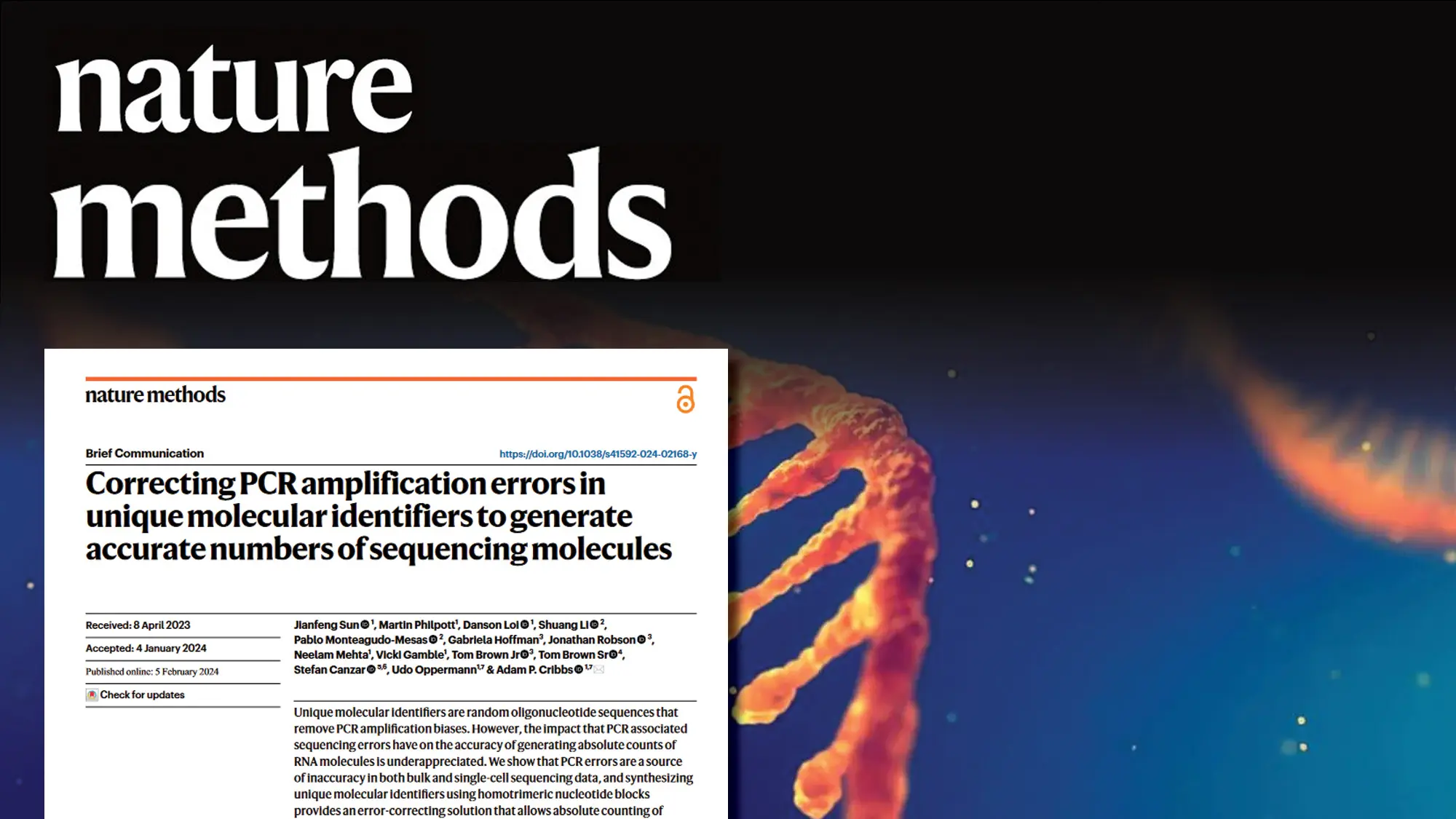
In collaboration with ATDBio, the team developed a new approach involving homotrimeric unique molecular identifiers (UMIs), random oligonucleotide sequences that, in addition to acting as molecular barcodes, can identify and correct PCR errors. Homotrimeric UMIs offer significantly improved error correction compared to monomeric UMIs and, in combination with advanced computational methods, allow fewer sequencing reads to be lost - this is particularly important in single cell sequencing, where sample material is often limited and extensive PCR amplification is required. The study, entitled Correcting PCR amplification errors in unique molecular identifiers to generate accurate numbers of sequencing molecules, was published in Nature Methods earlier this week.
"By constructing UMIs from homogenous blocks of nucleosides, we aimed to improve error correction in both short- and long-read sequencing, showcasing our commitment to enhancing sequencing technology applications," said Dr Cribbs. Dr Tom Brown, Managing Director of ATDBio and co-author on the paper, added "The synthesis of oligonucleotides and barcoded beads containing homotrimeric UMIs was challenging, but we were delighted that the improvement in sequencing error correction was so significant. This is a perfect example of how ATDBio can produce highly complex oligonucleotides, to help our customers and collaborators make genuine advances." The team is now working on further improvements to the bead design to provide even more accurate sequencing results.
By constructing UMIs from homogenous blocks of nucleosides, we aimed to improve error correction in both short- and long-read sequencing, showcasing our commitment to enhancing sequencing technology applications.
Associate Professor of Computational Biology, University of Oxford; and Co-Founder and CTO, Caeruleus Genomics